A watering system can appear to be working perfectly from a distance while still drifting away from the performance it was designed to deliver. Lawns may stay green enough, planting may survive, and timers may still be running on schedule, yet small issues often build quietly in the background. Irrigation maintenance services are less about reacting to obvious failures and more about preserving consistency before performance begins to slip in ways that are expensive, wasteful or difficult to spot at first.
This is where ongoing care tends to be misunderstood. Many people assume maintenance simply means replacing broken parts when something stops working. In reality, a well-run irrigation setup depends on a more careful process of checking, adjusting and monitoring how the system is behaving across the landscape as conditions change.
It Starts With Knowing Whether the System Still Matches the Site
No garden or landscape stays exactly the same. Planting matures, root zones expand, surrounding vegetation changes, and weather patterns shift from one season to the next. A system that was correctly calibrated when first installed may no longer be delivering the right quantity of water to the right places months or years later.
Ongoing care begins with assessing whether the system still fits the environment it is serving. That means looking beyond whether water is coming out of the sprinklers or drip lines and asking whether the coverage remains accurate, whether certain areas are now shaded or exposed differently, and whether usage patterns still reflect the needs of the site.
This part of maintenance is important because irrigation efficiency is not static. Even a professionally installed system benefits from periodic review as the landscape evolves.
Distribution Problems Are Often Subtle Before They Become Visible
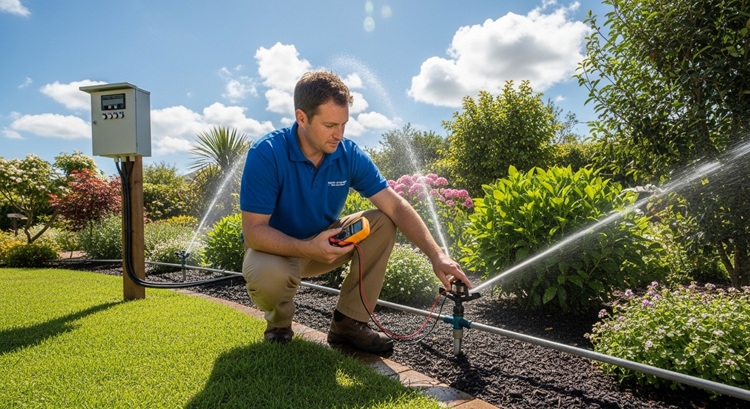
One of the more frustrating aspects of irrigation issues is that they rarely announce themselves early. A slightly blocked nozzle, a head that has shifted position, or a pressure imbalance across a section of the system may not create immediate visual damage. The system continues to run, which gives the impression that everything is fine.
The problem is that uneven distribution tends to show up gradually. One area may begin drying out while another becomes wetter than intended. Plants respond at different rates, making the issue harder to trace back to irrigation performance. By the time the symptoms are obvious, the underlying inefficiency may have been in place for some time.
Regular care helps catch these changes before they affect the appearance or health of the site too noticeably. That is one of its biggest advantages. It deals with drift rather than disaster.
Timers and Settings Need More Attention Than People Expect
A common assumption is that once a controller has been programmed, it can largely be left alone. In practice, settings often need reviewing far more often than people think. Watering duration, frequency and timing should all reflect current conditions, not just the settings that made sense when the system was last adjusted.
Changes in season, rainfall, temperature and plant growth all influence how much water is actually needed. If schedules stay the same year-round, the system is likely to become either inefficient or inadequate. What seems like a stable routine may actually be wasting water in one season and underperforming in another.
Ongoing care includes reviewing whether those settings still make sense. This part of maintenance is not always visible, but it has a major effect on performance and water use.
Wear and Tear Doesn’t Always Look Dramatic
Outdoor systems deal with dirt, pressure fluctuations, temperature changes and everyday exposure over long periods. Components do not need to fail completely to cause problems. They may simply become less precise, less reliable or less efficient.
A valve that opens inconsistently, a seal that begins to weaken, or a connection that develops a slow leak can all affect the wider setup. These are not dramatic issues on their own, but they alter how the system behaves. If left alone, they also tend to place extra strain on other parts of the network.
This is one reason ongoing maintenance matters so much. It recognises that the condition of a system exists on a spectrum. There is a lot of ground between “working perfectly” and “broken”, and much of the most useful servicing happens in that middle space.
Good Maintenance Protects Water Efficiency as Well as Performance
An irrigation system should not only keep a landscape healthy. It should do so efficiently. When maintenance is neglected, water waste often increases without being immediately noticed. Misaligned heads, incorrect schedules and slow leaks can all consume more water than necessary while delivering poorer results at the same time.
That combination is particularly frustrating because it means the system is underperforming and using more resource to do it. Ongoing care helps bring those two priorities back into line. It keeps watering patterns closer to what the landscape actually needs and reduces the likelihood of hidden inefficiencies building up over time.
In many cases, good maintenance is as much about restoring accuracy as it is about fixing faults.
A Well-Run Setup Is Usually the Result of Quiet, Consistent Attention
The best irrigation systems are often the least noticeable. They do their job in the background, supporting lawns, planting and outdoor spaces without drawing attention to themselves. That kind of consistency is rarely the result of installation alone. It usually comes from sensible, regular care that keeps the system aligned with the site and responsive to change. Ongoing maintenance is not about turning irrigation into a constant project. It is about preventing avoidable problems, protecting efficiency and making sure the original investment continues to perform properly over time. In that sense, a well-run setup is not one that never needs attention. It is one that gets the right attention before small issues become bigger ones.